





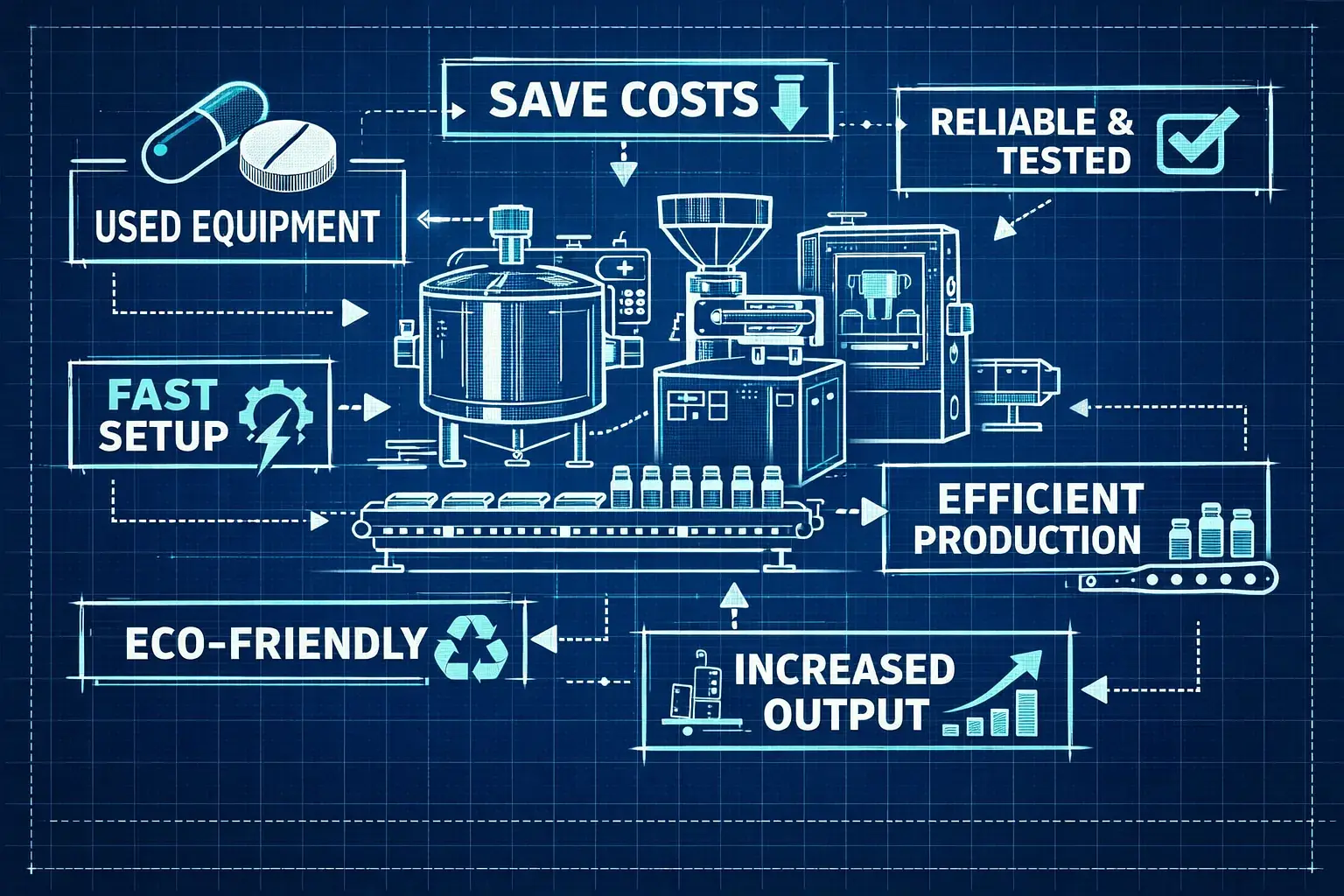
Used pharma equipment can cut capital outlay significantly and bring production online weeks sooner than waiting for new machines. Long lead times for new equipment often decide whether a launch hits its deadlines or slips. Whether you are launching a product, scaling capacity or covering a short-term gap, these five advantages change how you should approach procurement and cash flow.
This article explains what pre-owned and reconditioned pharmaceutical machinery delivers: lower capex, faster deployment, access to premium brands at lower cost, and the ability to install used machines or complete production lines with confidence. Below are typical saving ranges, lead-time comparisons and practical questions to ask sellers so you can decide whether used pharma equipment is the right choice for your line.
Key takeaways
- Immediate capex savings: Buying used typically cuts upfront cost 70-90%. This frees budget for other ventures in your business.
- Faster deployment: Shorter lead times for stocked or reconditioned machines commonly save weeks to months compared with new orders. We discuss this in more detail within our New Vs Reconditioned Blog.
- Inspect and validate: We only procure equipment that will be suitable for reliable and valid manufacturing. Our standards in our reconditioning process remain high, as per our blog- How We Add Value.
- Logistics: Our services can help with crating, paperwork and shipping.
Five advantages of Used Pharma Equipment
- Lower up‑front capital: Purchasing used pharma equipment typically reduces capex to 10-30% of the original new list prices, freeing funds for validation, staffing and market entry so teams can prioritise commercialisation instead of tying money into long lead‑time purchases.
- Faster deployment: Stocked or properly reconditioned machines can ship in weeks rather than the 6 to 18 months that new builds often require, reducing the need for temporary outsourcing and limiting capacity shortfalls.
- Access to premium brands and higher specs: We supply trusted machines, like IMA and Bosch, at lower used prices. These make upgrades to your production line at a fraction of new cost.
- Operational certainty: Our procurement and engineering maintain high standards. Most of our equipment have low operational hours and come in an excellent condition.
- Lower embodied carbon and circular‑economy benefits: Buying second‑hand recovers value from redundant assets, reduces disposal costs for divesting plants and supports sustainability claims for stakeholders. Many of our blog posts discuss sustainability and carbon saving, link here: https://www.poseidon-pharma.com/blog.
Understand realistic prices and what affects cost
Asset prices are hugely dependent on size of machinery, output and make of the machine. Understanding benchmarks is critical, which will require independent research. A great example is PPUK's Groninger Filling Line, which brand new is valued in the region of ~ £600,000.
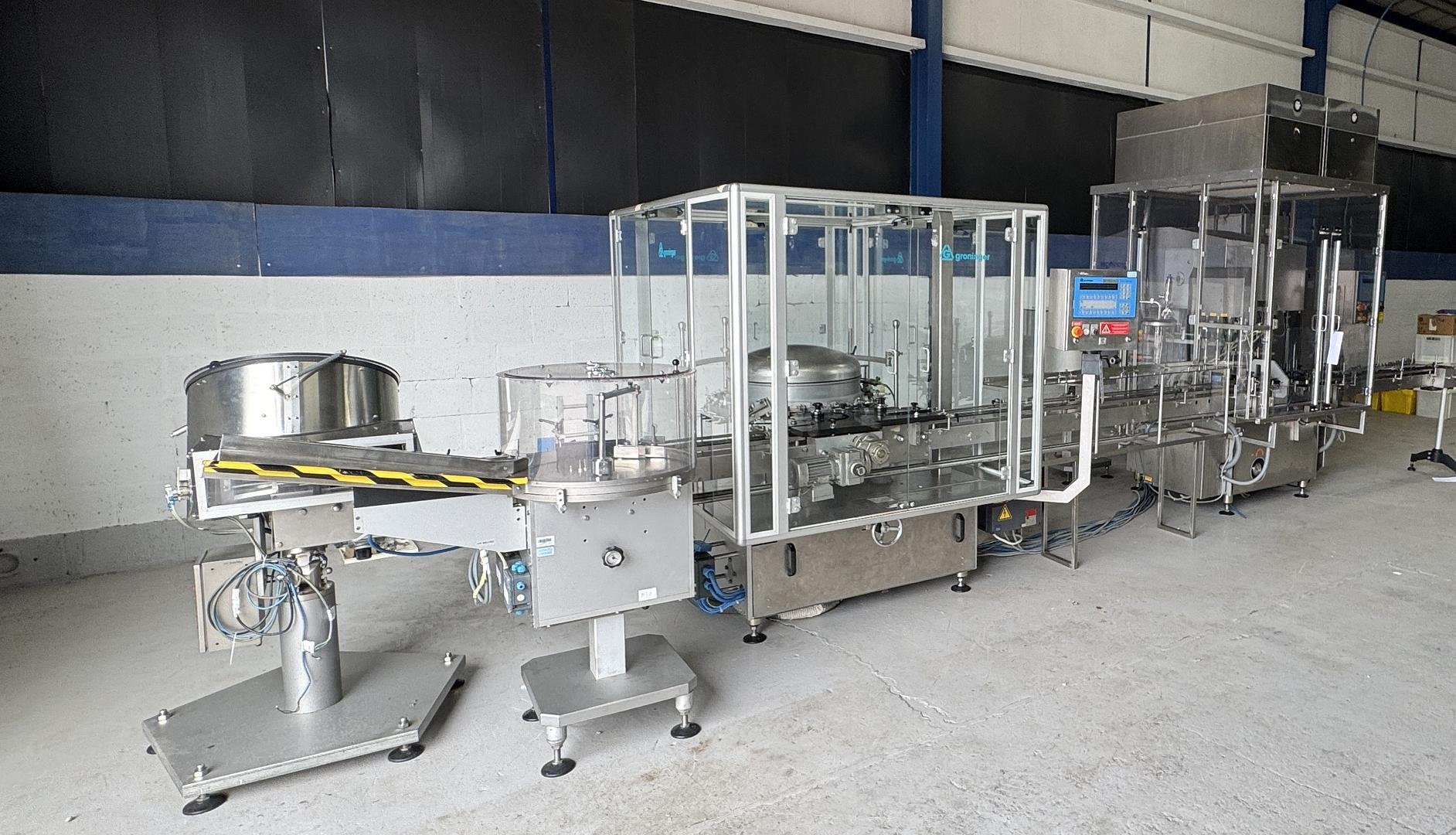
At a reconditioned price, this type of line is reconditioned and sold at 10% of the brand-new value (~£60,000).
Sellers sometimes exclude costs that affect the landed price, so budget separately for revalidation, spare parts, electrical rewiring, transport and on‑site commissioning. Request running videos, spares lists, records, shipping estimates. Those items act as negotiation levers and reveal the true cost before you start inspection and acceptance checks.
Where to buy used pharma equipment: trusted suppliers and marketplaces
Start with established regional players and specialist marketplaces when you need traceability and speed. Most specialists in the industry list their equipment through auction houses, brokers and online platforms. Consider listing services and marketplaces such as RESALE, EquipNet, and Exapro or auction houses like Maynards Europe pharmaceutical auctions.
Once contact has been made with sellers, it is wise to have short practical checklist before you commit: ask for clear, dated photos and high‑resolution video walk‑throughs, warehouse inspection reports and prior buyer references. For more, see industry guidance on GMP-compliant equipment design and related peer-reviewed guidance on pharmaceutical quality and risk management).
How to inspect used pharma equipment before you buy (on‑site checklist)
Visiting a site is a useful tool to really see the equipment working; use a concise checklist so critical verification steps are not missed. Confirm serial numbers and nameplates against paperwork, then power the machine and run full function tests where safe and permitted. During test runs, observe alarms, interlocks and safety stops and check the machine completes cycles without unusual noise, vibration or leaks.
Inspect physical condition for corrosion, welded repairs, oil stains and any signs of product ingress in process areas. Open panels, where allowed, to confirm wiring and PLC labelling match drawings, and check bearing housings, seals and sight‑glasses for wear. Capture high‑resolution photos and time‑stamped video clips so you have verifiable evidence for later review.
Deal breakers include missing IQ/OQ/PQ documentation, inconsistent serial numbers, undocumented internal repairs and any evidence of past contamination. If core safety devices or control modifications lack records, walk away. After inspection, structure FAT and SAT acceptance tests with clear pass/fail criteria so installation and validation proceed smoothly.
Calculate total cost of ownership and your ROI
Shipping and installation need to, also, be considered for a good deal. Shipping and installation will be dependent on the size of the machine. It is recommended to get firm quotes up front for freight, rigging and commissioning to avoid surprises and to strengthen your position when comparing suppliers.
- Obtain a freight quote that includes crate and dunnage specifications plus transit insurance limits. Include expected lead times and handling conditions so carriers and insurers understand the machine's requirements — use carriers that publish cost-to-ship estimates for pharmaceutical products as a benchmarking reference.
- Request a rigger and on‑site lift plan with day rates and mobilisation costs. Confirm the rigging plan matches factory constraints and planned installation dates.
- Get an installation, IQ/OQ and validation estimate with deliverables and a timeline. Clarify who supplies test protocols and who signs off on acceptance to prevent delays.
- Budget for customs, VAT, any duties and any temporary import bond costs for cross‑border moves. Confirm documentation requirements early so customs handling does not hold up delivery.
Spare parts, service and maintenance typically shape lifetime cost more than the purchase price. Check age, OEM part numbers, interchangeability and whether suppliers’ stock critical spares for the model.
Use a compact ROI formula to compare options: Payback months = (Purchase + Shipping + Installation + Revalidation + Initial spares) / Monthly incremental margin. For example, if a new line costs £500,000 and a used purchase is £150,000 plus £40,000 for shipping, validation and spares, and you expect an incremental margin of £10,000/month, payback = (150,000 + 40,000) / 10,000 = 19 months. Run this calculation with your figures to compare used versus new procurement and shape negotiation points.
Next steps: a buyer’s flow and how PPUK helps you buy with confidence
Poseidon Pharmaceutical UK LTD aim to provide a good customer experience as well as high-quality reconditioned equipment. Alike to similar businesses, we will see all our enquiries through the correct procedure and transparency.
We recommend taking these immediate actions: email a brief URS to us and subscribe to our LinkedIn for updates on our stock and industry takes.
For more resources and regular updates, see our blog. Used pharma equipment can deliver faster payback than buying new because upfront cost is lower and equipment can arrive sooner.
Contact Poseidon Pharmaceutical UK LTD for any support via our contact us page.
Make used pharma equipment work for your production line
Used pharma equipment can expand capacity with much lower capex when you pick the right assets. Understand the main price drivers, including age, OEM, automation level and reconditioning status, so you avoid paying for perceived features. That focus keeps procurement decisions practical and measurable.
Request a tailored equipment shortlist from Poseidon Pharmaceutical UK LTD.
Tell us the machine type, required throughput, budget and then request a tailored equipment shortlist from Poseidon Pharmaceutical UK LTD. Start there and turn surplus savings into reliable production capacity whilst supporting a circular economy.
Poseidon Pharmaceutical UK LTD
02/03/2026